

I think many of us have gotten used to telling the story of science in reverse. Most people probably think that the biggest leaps in science start with theory first, experiment second, and application last. You also hear this kind of thinking in sayings like, “once we figure out the science, all that’s left is engineering.” However, if you look throughout history, the most important breakthroughs often run the other way. They start with improvised experiments that reveal new phenomena, which then ripple outward, changing both industry and theory.
Which is to say, our civilization rests not only on grand theories, but on the curiosity of tinkerers willing to play at the edges of the unknown. Tinkerer is kind of a sorry-sounding word, with rather unserious aesthetics, but inventor is really a term that applies once someone has invented something. I’m interested in the kind of person who spent years giving form to their curiosities, uncertain if anything they did would end up in an invention. I think their example is an underexplored template for how greater progress can be achieved in the realm of science and technology, and in that vein, I wanted to highlight four world-historic tinkerers whose experiments formed the foundation for modern science and industry. These are James Watt, Philo Farnsworth, Charles Townes, and Theodore Maiman.
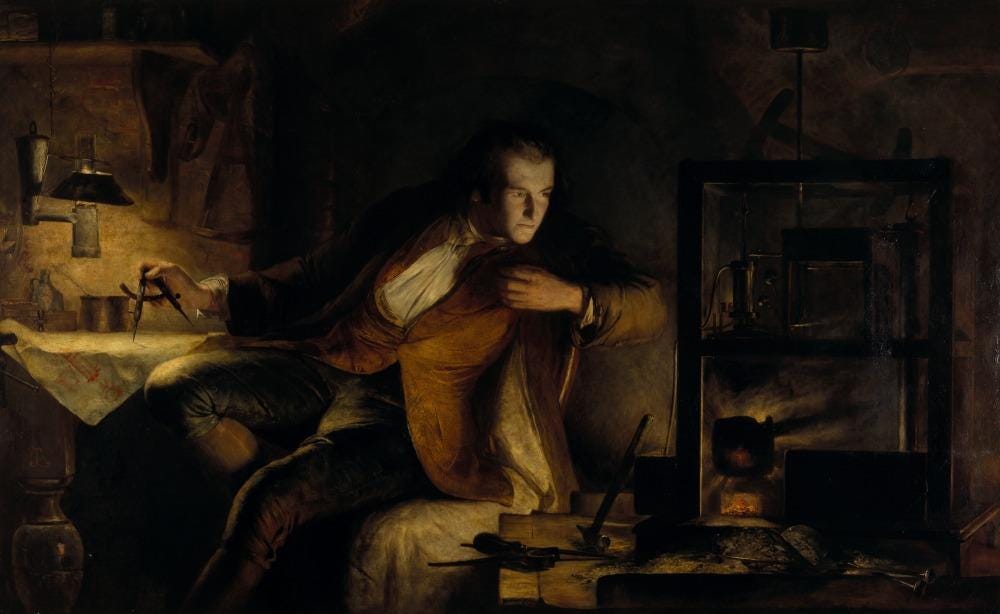
James Watt did not begin as a great man of science. He was a Scottish toy maker who delighted in building odd contraptions. He then worked as the instrument repair guy at the University of Glasgow, and for years, was known more for his mechanical amusements than for anything of industrial importance. The university was home to one of the first steam engines of the time, called a Newcomen engine. The story goes that the engine broke, and they asked Watt to fix it.
The Newcomen engine was mostly used to pump water out of mines. It worked by boiling water into steam, using that steam to push a piston upward, and then cooling the same chamber with a rush of cold water to bring the piston back down. This design wasted enormous amounts of coal because the same chamber had to be reheated and recooled over and over again. Rather than fixing a broken model, Watt ended up redesigning the entire system himself.
The breakthrough was quite simple. Instead of cycling hot and cold in the same cylinder, he added a second chamber, called a separate condenser, where the cooling could happen independently. This small, mechanical tweak transformed the engine’s efficiency. The Newcomen piston only moved linearly, up and down. Watt arranged the pistons to create rotary motion, which, overnight, unlocked entirely new applications, from spinning wheels in textile mills, other forms of industrial equipment, and eventually, locomotives.
Watt’s name became the unit of power itself, and his improved engine spread as a universal source of industrial energy. Its significance went deeper, still. The steam engine and the ability to improve its efficiency drew a whole new set of questions for engineers and natural philosophers of the day. What was this mysterious heat, at the time called “caloric,” that could be converted into motion? How much more could we push an engine’s thermal efficiency? This very question, a few decades later, led to the French engineer Sadi Carnot’s discovery of the limits of engine efficiency, now known as the Carnot limit.
That insight shattered the prevailing Newtonian framework of energy as perfectly conserved, showing instead that some portion must always be lost as unusable heat. From there, a whole new science was born, which still reigns to this day. Thermodynamics. The notion that entropy is always increasing, as a universal law, became one of the most consequential ideas not only in physics but in philosophy. I’ll leave it here for now, but I wrote more about this idea in an essay called The Many Lives of Energy, which you can read here.
Philo Farnsworth was one of the last great American tinkerers and inventors. He was born on a farm in rural Idaho, the son of Mormon settlers. Farm life tended to make you self-sufficient by necessity. If the refrigerator broke, you had to figure out how to fix it on your own. Same with the hand-crank engines, the water pumps, the combines and balers. Farnsworth developed a fluency with machines and spent many of his nights reading science magazines in his attic. One particular idea caught his fascination. At the time, radios could transmit sound through the air, but Farnsworth had read about a hypothetical device that could transmit images through the air as well.
At the time, the only means of transmitting images was mechanical. You had a film of tape with a sequence of photographs. The film moved sequentially and linearly in one direction, and this linear motion created the illusion of movement that people followed. The images had to be first printed onto a film and then displayed. This created a time gap between the collection of the images and their display.
Farnsworth believed that it would be possible to remove this gap entirely and have images be captured on one end via a camera and immediately transferred via radio waves to a viewing screen.
One day, as he was guiding a horse-drawn plow through rows of his family's crops, an idea took root. If images could be broken into lines, like the furrows in a field, maybe they could be scanned, transmitted, and rebuilt somewhere else without delay. What’s remarkable is that Farnsworth was 14 at the time that he had the idea for the television. He drew a primitive diagram of the idea and showed it to his high school’s science teacher, who validated its principles.
The idea lived on in Farnsworth’s mind for years, until at 19, he mentioned it to a local banker named Leslie Gorrell. Remarkably, in what might have been one of the first venture deals ever, Philo Farnsworth was seeded with $6,000 by Gorrell and George Everson, a San Francisco businessman, to develop the world’s first television. Farnsworth then did what any startup founder does these days — move out to San Francisco. He moved into a lab at 202 Green Street, and within two years, he succeeded in demoing the first functioning television. To briefly describe how it worked, on the transmitting side, a lens was focused on a photosensitive surface, scanned with a narrow beam of electrons, picking up the brightness of each spot across the rows, and transmitting the brightness of each spot via an electrical signal. This signal could be transmitted as a radio wave through the air, and at the other end, the image could be rebuilt with a vacuum tube, an electron beam, and a phosphor-coated sensor. The beam would scan across the screen in the same pattern as before, line by line, and light up the screen based on how strong the signal was.
This development laid the groundwork for everything from broadcasting to computing, long before the world had a language for bits or networks. What makes his story remarkable is not just the invention itself, but the fact that the person who achieved it did so far outside the academy, even outcompeting rival efforts pursued at labs loaded with millions in funding (RCA — more on this in a separate post perhaps; it’s a fascinating and frustrating story.) To me, this is proof of the thesis here, that there is so much in the middle that can be discovered and exploited, so much that many of us likely overlook all the time. All it takes is the right person, exploring freely, to point it out to us.
Finally, the last example I’ll mention is that of Charles Townes & Theodore Maiman. Townes was a Columbia physicist and in 1951, while sitting on a park bench in Washington, D.C., he had the breakthrough that led to the maser, microwave amplification by stimulated emission of radiation. He wanted to force atoms or molecules to emit energy in step with each other, amplifying the signal until it became a single, sharp frequency. To do this, they used ammonia molecules, and by shooting them through a special chamber shaped to bounce microwaves back and forth, the molecules stimulated one another to release energy in unison. The result was a beam of microwaves that was astonishingly pure, far more precise than anything electronics alone could produce at the time.
But even after he built it, many of the most celebrated physicists of the time didn’t believe him. Townes told a story of walking with Niels Bohr and explaining that his oscillator was producing an astonishingly precise frequency. Bohr flatly refused, “No, no, that’s not possible.” He insisted Townes must have misunderstood. Bohr was thinking of the uncertainty principle. A single molecule only spends a short time in the cavity, so its frequency can’t be measured very precisely. From a theorist’s perspective, the whole thing looked impossible.
What Bohr didn’t realize was that Townes wasn’t relying on one molecule; he had a whole collection of them, and he used electronic feedback amplifiers. The principle was quite simple. If you take a noisy signal, feed part of it back into the system, and continuously adjust it, you can smooth out the noise and lock in on a single clean frequency. It’s the same trick that lets radios tune precisely to one station or microphones cancel their own feedback squeal. “Any engineer knows that, but Bohr didn’t recognize thi,s and he just shut me up. He wouldn’t listen,” wrote Townes.
Microwaves were one thing, but light was thought to be inherently messy and diffuse, like the glow of a bulb scattering photons in every direction. Townes and his brother-in-law, Arthur Schawlow, published a 1958 paper proposing an ‘optical maser,’ but many in the field considered it impractical, and even Townes doubted that familiar materials like ruby could work.
That was the backdrop when Ted Maiman entered the picture. In the early sixties, he was a young engineer at Hughes Research Laboratories in Malibu, tinkering with optics in a modest, low-budget lab. He wasn’t a famous theorist, he didn’t have a big team or lavish resources, but he believed ruby wasn’t hopeless. By carefully analyzing its properties and pairing a synthetic ruby crystal with a powerful flashlamp, he built a resonant cavity that forced light to align, producing a monochromatic, coherent, collimated pulse of light. The first laser.
Funny enough, after this success, many called the laser a ‘solution in search of a problem,’ but in hindsight, it was one of the most transformative inventions of the twentieth century, and the impact of the laser has still not waned. They are used nearly everywhere, from driving the fiber-optic cables that carry the world’s data, to semiconductor fabs that etch our microchips, to various medical treatments like LASIK and ablation. They have enabled spatial scanning through LIDAR to industrial applications like laser welding and cutting. Now, they even underpin our most advanced defense systems.
Here’s how Townes described its reception in the scientific community. “It is fairly typical in the development of science — it is now a very big science, it’s very big industrially, it was completely ignored by industry initially — not a field of interest — but it’s become very important. Well, we must be open to new ideas. Also, note that somebody tried to stop me, even important physicists tried to stop me. Industry wasn’t interested at all, important physicists told me it wasn’t going to work, and even after I had it going some important physicists told me no, that’s impossible, that’s crazy, you don’t understand, you’ve done something wrong, you don’t know what you’re doing. New ideas are new, we’ve got to be open to new ideas and encourage people to explore new things, even the things that we’re not very sure are going to work, or we think won’t work, but it’s good to explore. Another thing to remember is unpredictability. We frequently can’t predict new things. And so we must again allow people to stick to new possibilities, explore new things, because we don’t know where we are and what we’re missing. In fact, all the scientific information needed for lasers was recognized as early as about 1920. We knew all the physics involved by as early as 1920.”
Today, experimentation is more powerful and more accessible than ever before. The tools that once cost millions now fit on a desktop. We have open-source software, modular hardware, and vast global communities where someone in a garage can prototype ideas that once required a corporate lab.
And yet, oddly enough, the spirit of independent, headstrong experimentation has been somewhat fenced off. Many turn their nose up at those without prestigious credentials. Others have to contend with more frustrating realities of many modern hardware systems, like companies sealing off the guts of a device, sometimes making it illegal to open the contents of a device you own! This is what the right-to-repair movement is all about, the simple freedom of being able to take things apart, to fix, and to understand.
In The Right Stuff, Tom Wolfe once explained why so many of the best engineers of the early space missions came from the Midwest. They grew up as tinkerers. Just like with Farnsworth, if the car broke, or the water pump, or the refrigerator, there was no one to call. You fixed it yourself. You learned the stubborn craft of figuring things out with your hands. David Lang has the fascinating insight that the true American dream isn’t the home with the picket fence, it’s the American garage. The garage is the symbol of creativity, ingenuity and freedom. It’s space for a bandsaw, a workbench, and the kind of self-determination that makes whole new worlds possible.
These pursuits are not idle craft. They are, and always have been, the necessary predecessor to great invention. Watt at his workbench, Farnsworth on his farm, Maiman in his lab, each began with the simple act of tinkering and exploration. If I were to make one prediction about the future of science and progress, it’s that the next leap won’t emerge from the ivory tower, but from a resurgence of this practice.
This blog is a written version of a talk I gave at Edge Esmeralda a few months ago. Thanks very much to Cameron Wiese for inviting me, and to the Abundance Institute for sponsoring the event.
This is awesome! I wonder whether modern life has reduced the socially acceptable time and space for tinkering (e.g. unemployment seen as something to escape immediately). I think there's a similar pattern in mathematics, where many preindustrial discoveries came from aristocrats (Gauss, Fermat etc) who simply had the freedom to explore + didn't have to justify their time to their peer group.
This was so interesting. The idea of tinkerers for some reason made me think of Brie Wolfson's "Flounder Mode." It reclaiming a word that may be use derisively and highlighting its virtue.
I'm not as well versed in the history and science and inventions as you, but I do buy your thesis about innovation coming from these individuals; which I think creates an interesting counter point to the concern on the massive defunding of scientific research in the US right now. I don't think we have to see this as a binary (tinkering vs. institutional/large private research), but perhaps as the scientific communities try to figure out where to go from here, we can celebrate tinkerers and encourage them from every corner of the world (we need innovation now more than ever).
Great stuff, Anna-Sofia—I'm a big fan of your writing and look forward to having your books on my shelfs any day now (no pressure!)