

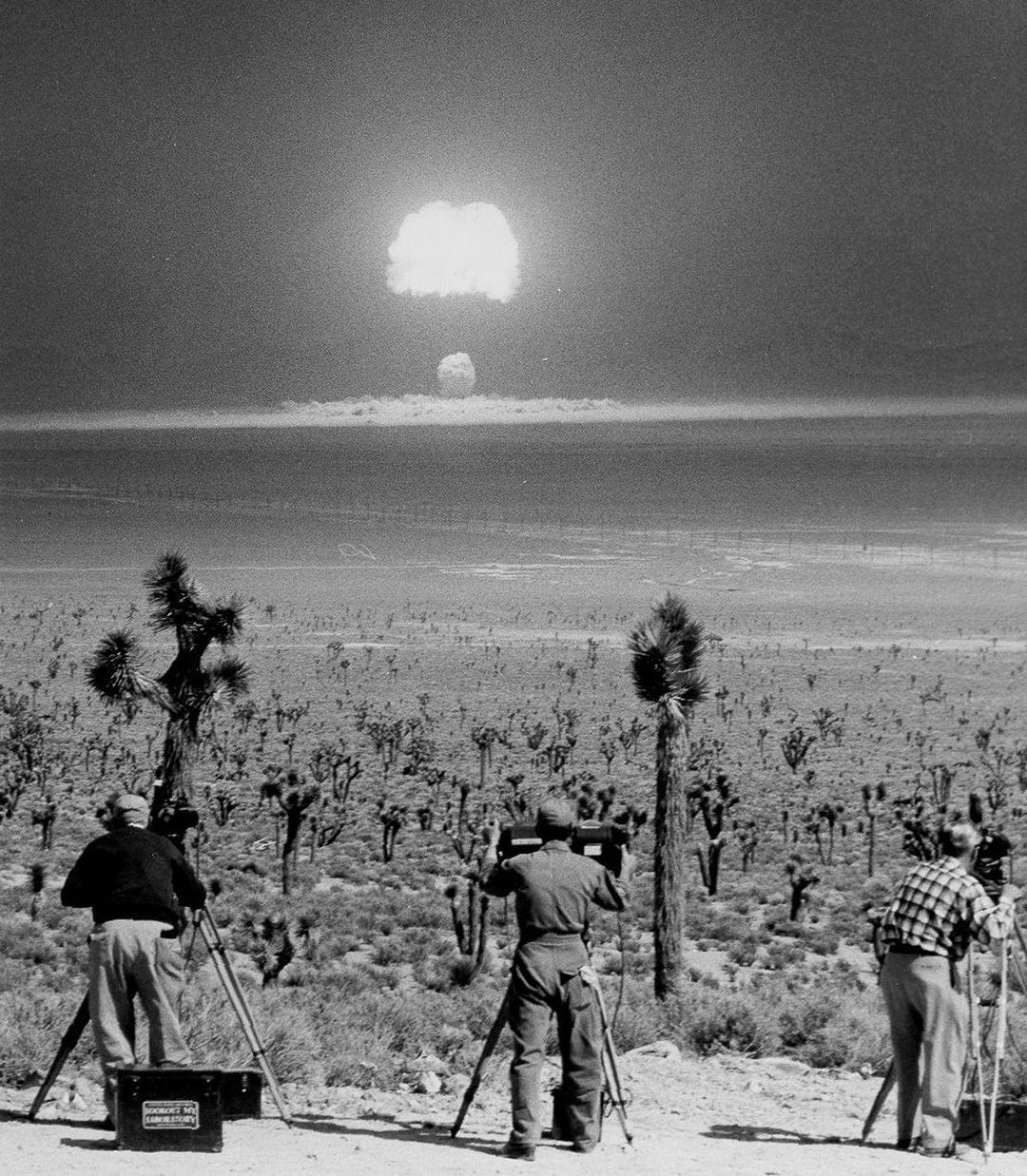
It took the French ten years and well over a million workers to dig a hundred-mile-long ditch through the Egyptian desert that would connect the Mediterranean and Red seas, cutting the shipping route between Europe and Asia by thousands of miles. The Suez Canal, when finally opened in 1869, was easily one of the greatest engineering achievements of the nineteenth century. Nearly overnight, over ten percent of Britain’s total global trade started flowing through the strait, which quickly became the “jugular vein of the British Empire,” so when Egypt nationalized the canal in 1956, the British government lost its mind. The pound collapsed, Prime Minister Eden resigned in a feat of total political self-immolation, and the British Empire was brought to its knees.
The Americans watched closely. They were witnessing the definitive end of one empire, and the dawn of their own. It occurred to a few scientists at Lawrence Livermore that perhaps a rival canal might be opened, one that would make global commerce impervious to the politics of the Egyptians. You could carve such a canal right through Israel’s desert, and you could do it with a very fancy new construction technology that wouldn’t require ten years or millions of laborers. That new technology was, of course, the nuclear bomb. Livermore scientists drew up a draft proposal for detonating 520 2-megaton bombs daisy-chained through the Negev, which, to put in context, is 520 bombs, each with over one hundred times the destructive force of those dropped on Hiroshima. By 1957, the US successfully contained a nuclear explosion underground in a world-first, which suddenly made nukes for earth-moving purposes seem pretty plausible.
The Negev project was ultimately shelved for reasons, but the idea that the rules of geopolitics, regional power dynamics, and entire economies could be re-orchestrated with the carefully engineered detonations of a few subterranean nuclear devices lingered in the imagination — particularly in the mind of one central character, for whom seemingly any problem could be solved with megatons. Edward Teller, of course.
Bombs-as-shovels was already a well-established idea since the days of Alfred Nobel, but the atomic bomb promised to be the most efficient shovel ever devised by mankind. The possibilities were already obvious to pioneers of nuclear science the world over, and as atomic weapons became objects of public terror, it became quite politically convenient to rebrand nuclear explosions from being simply tools of mass destruction to tools of mass construction!
Here were the words of a Soviet representative in the UN following his country’s first successful nuclear test in 1949.
“Although the Soviet Union would have as many atom bombs as it would need in the unhappy event of war, it was using its atomic energy for purposes of its own domestic economy; blowing up mountains, changing the course of rivers, irrigating deserts, charting new paths of life in regions untrodden by human foot.”
In ‘57, Teller’s group at Lawrence Livermore gathered to discuss further prospects of nuclear explosives for peaceful purposes, whereupon a skeptical attendee, Isidor Rabi quipped, “So you want to beat your old atomic bombs into plowshares?” Rabi was referring to Isaiah’s vision of a future in which God makes war obsolete by beating swords into plowshares and turning spears into pruning hooks. It was a sarcastic comment, but was also incredibly apt for the objectives of the United States, so it stuck.
Project Plowshare became President Eisenhower’s — and Edward Teller’s — personal attempt at a New Deal, but with nukes this time. And, everything was on the table. You could build highways and railroads through mountains! Create artificial aquifers! Spawn new harbors! Generate straits! Unlock natural gas in the Rockies!


Edward Teller became the most vocal advocate of what was really on the table. For him, Plowshare was a whole new vision that would secure material abundance, a cleaner environment, cheaper civilian and commercial transport across the Americas, and much, much more. In an essay called Nuclear Ecology, he wrote, “In order to clean up our continent, in order to keep the civilized world free of dangerous contamination, we not only should tolerate Plowshare — we need it.” Below are just a few of the applications Teller saw Plowshare unlocking.
Mining & refining in situ!
“Instead of mining the raw materials, the nuclear device might supply the energy to utilize the Earth itself as the crucible, with only the useful reaction products mined and purified.”
Fracking for gas — with nukes!
“There is once again as much natural gas in the United States than the amount I have already mentioned; only, this additional one hundred percent is contained inside tight rock formations from which we cannot extract the gas in an economical manner. By exploding a nuclear device a few thousand feet underground, one can loosen up the rock formations and produce the appropriate rubble chimneys. Thus we have an excellent chance to make these additional amounts of gas available.”
Storing all that gas!
“Gas is consumed in our big cities and the demand is much greater when there is a cold spell. Gas is brought in by pipelines. We need storage space for this gas, and on the eastern seaboard all the natural storage space has been exhausted. We could produce lots more storage space by nuclear explosions. Similar storage places could be used in any location where gas is brought in by ships in a refrigerated form. The storage space could be established below the sea bottom on the continental shelf and could be brought in to population centers by relatively short pipelines.”
Unlocking geothermal energy!
“Deep underground, much geothermal heat can be found. Logically enough, there seems to be a lot of it around extinct volcanoes, some of which are located all along the Pacific coast in the northwest part of the United States. A nuclear explosion could be used not so much to produce heat but to open up this geothermal reservoir. The explosion would produce a rubble cone, expose a lot of surface of the hot rock so that we can pump water down, convert it into steam and use it.”
Storing and distilling water!
“There are many people in the world and there will be more; a good life for the billions is, in the end, our great problem, and water is one of the most important necessities for a good life. Plowshare can be used to divert streams to store water, even possibly to distill water underground using, again, geothermal heat.”
Expanding shipping lanes to handle all of this material abundance!
“Many new ships have a displacement of 300,000 tons and ships of 700,000 tons are on the drawing board. Compared to these carriers, one may consider the “Queen Mary” as an oversized canoe. These carriers may become important not only to transport oil, but to haul iron ore from the abundant deposits of Northwest Australia to all corners of the world. The difficulty is that neither our canals nor our harbors can accommodate these new monstrous ships. Plowshare may be the best means by which to create the appropriate waterways and the necessary harbor facilities.”
Squeezing water out of moon rocks!
“One trend in the space age is that scientific exploration has become closely linked with undertakings requiring tremendous expenditures. For example, on a scientific expedition to the moon the cost of transporting each item of equipment would be exorbitant. Plowshare technology may afford the possibility of decreasing the total cost of such an expedition by supplying water released from lunar rocks by an underground nuclear explosion.”
It’s hard to overstate just how efficient nukes were for moving dirt and rock. They released energy far more rapidly than chemical explosives, on the order of microseconds versus milliseconds. This created powerful shockwaves underground that effectively liquified the earth, making it briefly behave like a fluid or even compressible gas. The big deal is that shattering and moving are normally two separate problems. Conventional explosives break rock, but broken rock is still just a pile of rubble sitting where it was. You still have to move it. The blast and the excavation are separate steps, and the excavation is often the harder one, but a nuclear explosion has so much surplus energy that not only does it break the rock, it moves it too. So, the shattering and displacement both happen in one step.
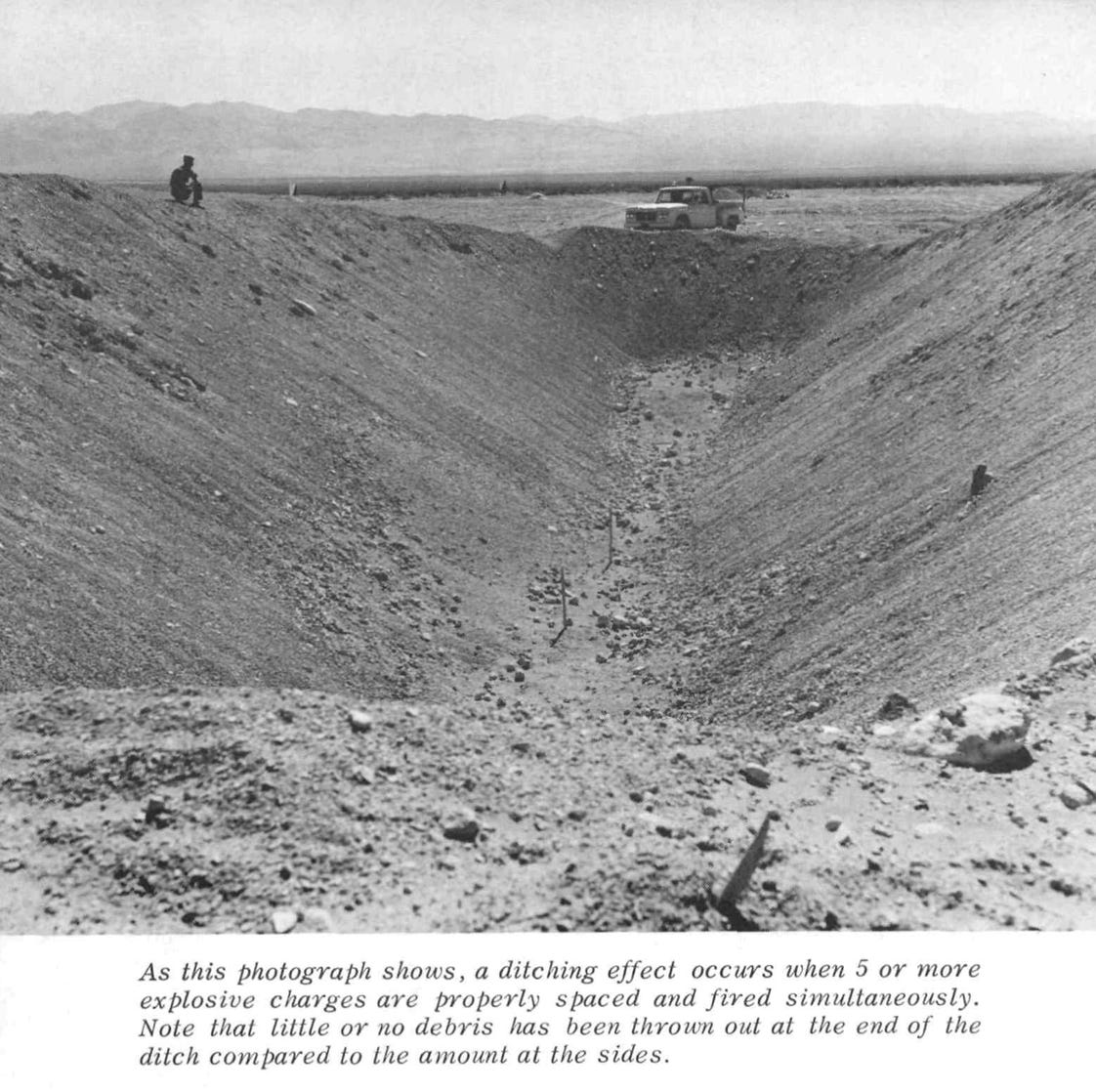
Also, the release of energy with chemical explosives scaled linearly. If you wanted to move more dirt, you needed that much more explosive, and the entire operation grew in proportion to the size of the hole. With nuclear explosives, the yield could rise by orders of magnitude while the device itself remained essentially the same size. A nuclear charge of a few kilotons might weigh only a few thousand pounds and fit down a 30-inch borehole. A 2-megaton nuclear charge could be placed in a 40-inch hole. The chemical equivalent, by contrast, would require a cube of explosive 100 meters on each side — an amount that represented several years of US industrial production.
And finally, the cost scaling was insane. In the sixties, the cost of a 10-kiloton nuclear device was $350,0001. The cost of a 2-megaton device was $600,000. So, for a 200x increase in energy, the cost barely doubled.
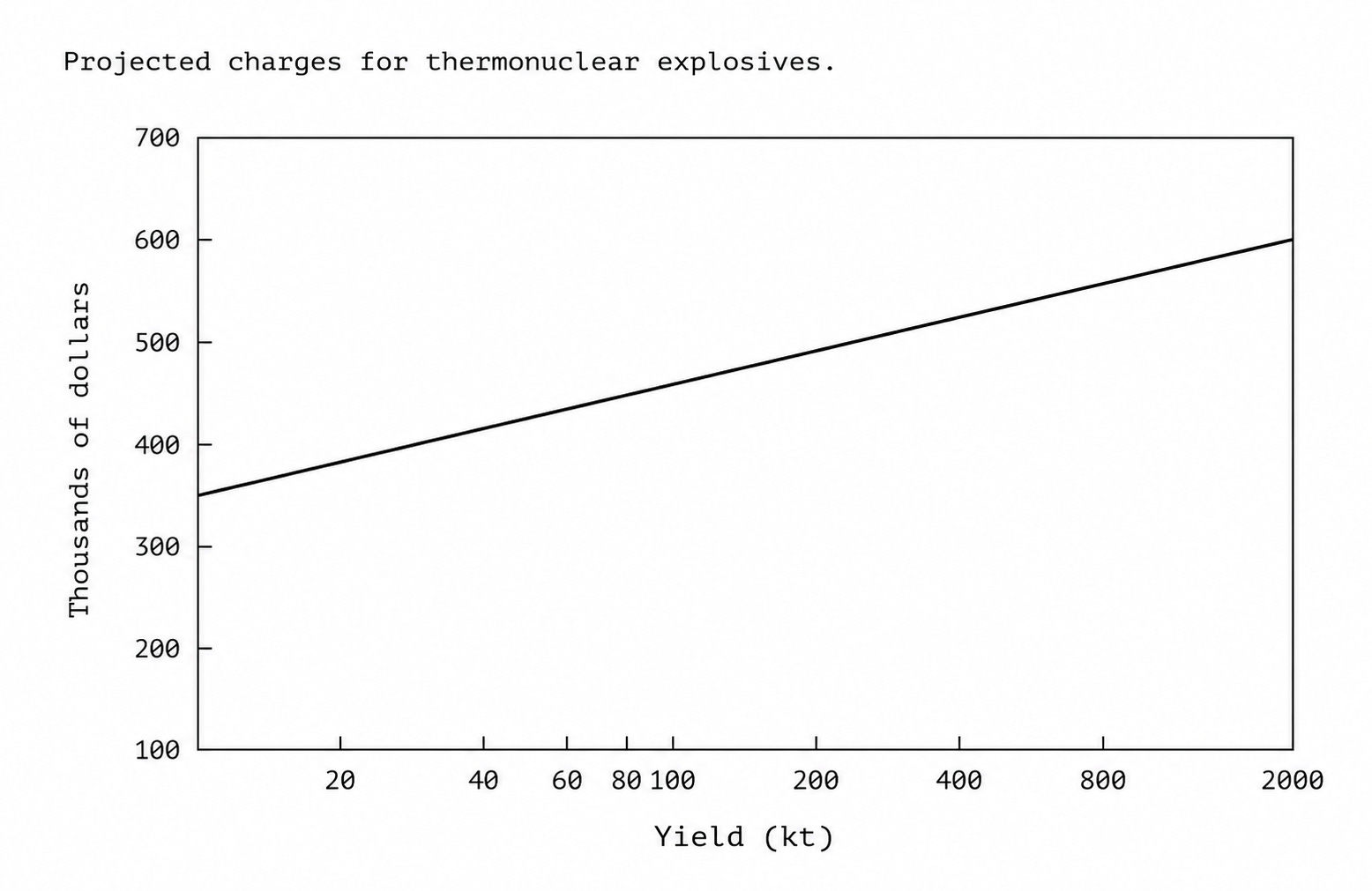
To put that into perspective — a ton of TNT was $460. A 10-kiloton nuclear device could deliver the same unit of energy for $35. A 2-megaton device could do it for thirty cents. So, a two-megaton nuclear explosive was 1,500 times cheaper per unit of energy than chemical explosives.
This was Teller’s whole point. It was suddenly unimaginably cheap to move insane amounts of Earth, to the point that we needed to start doing it everywhere, all the time. However, not everyone saw it that way. The US ended up conducting 26 nuclear tests through Project Plowshare between 1957 and 1973, but that paled compared to the 800 other nuclear tests being done across America during the same period, and not for peaceful applications. The explosions were really starting to freak people out, and people wanted the government to cut it out already. The oil & gas industry complained that they’d never get their money back by fracking with nukes, and even if they did, nobody wanted to risk the chance that they’d be cooking with radioactive gas.
Teller’s dreams of new harbors in Alaska, channels through the Marshall Islands, a new sea-level waterway through Nicaragua called the Pan-Atomic canal were all dashed. In his memoir, he wrote,
“The Plowshare project was funded just after I assumed the directorship. In retrospect, given the steadily increasing public hysteria over radiation, we should have given up without beginning. Bur even in 1958, only a few people could have guessed how the technique of using nuclear explosives for civil engineering would fail to develop.”
It was one of the greatest disappointments of his life, and he looked with admiration and envy at the Soviets, who, in 1965, started a parallel program for nuclear engineering, which they called “Nuclear Explosions for the National Economy.” Their program detonated five times the number of peaceful bombs as the United States did, and whereas the United States only did experimental tests with the nukes, the Soviets actually put them to work.
They — nearly — made the rivers run backward!
For centuries, the Russians looked over at their vast territory and were pained. The north of the country is filled with myriad rivers and lakes, all frigid, yes, but carrying millions of cubic meters of fresh water away into the Arctic Ocean, where no one needs it. Meanwhile, the agricultural heartland of Central Asia, across today’s Kazakhstan and Uzbekistan, is chronically water-starved. Since the tsarist days, visions of canals that would divert the flow of Siberia’s north-flowing rivers into the Volga and the Aral Sea basin loomed large in the imagination. The French were building canals in Egypt, why couldn’t they? It would mean a verdant Uzbekistan, make Kazakhstan an emergent breadbasket, double the annual production of cotton or “white gold”, and a perpetually replenishing Aral Sea. You could also imagine new hydroelectric power emerging along the new canals and novel river ports that would move goods between Central Asia and Europe. Of course, diverting water flow from Siberia’s rivers into Kazakhstan would require building thousands of kilometers of canals. It was one of the megaprojects the Soviet Union always had on its bucket list, and nuclear plowshares had real potential to make it happen. They tested the canal-by-nuke method in 1971, under the codename Taiga, by exploding three Hiroshima-scale devices 127 meters underground in the northern Ural foothills. 98% of the yield actually came from fusion reactions triggered by the explosions, which promised to produce less fallout, but the neutrons generated during fusion exploded over everything and transmuted the metals in the bomb casing into radioactive isotopes, and there was enough radioactive debris that other nations started complaining. Taiga was just a proof of concept. The actual plan — a 112-kilometer canal connecting the Pechora River in the north to a tributary of the Volga — would have needed another 250 of these detonations, and was probably going to be politically and economically infeasible. So, the result of Taiga was a crater that is now filled with water and called Nuclear Lake2. The giga-scale vision of diverting northern rivers into the Aral Sea basin was even more ambitious, so it was shelved, and the Aral Sea ended up drying up almost entirely. Interestingly, the vision of diverting northern lakes to the south still exists, and Russian politicians still talk about it, with a few holding out hope that this will finally supply freshwater to Central Asia or possibly even the northern farming lands of China at some point.
They mapped the mantle!
The majority of the explosions the Soviet Union did were in the service of geological exploration, like finding new natural gas or oil deposits. It’s technically called reflection seismology, which was used by oil & gas for a while — which is basically sonar for earth. You thump the ground, put a bunch of sensors called geophones around, and listen for when different echoes come back from down below. With enough sensors, you can get a rough idea of how many layers there are and what kind of rock you might be looking at. However, traditional thumping mechanisms like sticks of dynamite or thumper trucks3 could only penetrate about a few kilometers below the surface — and the most powerful thumper trucks can deliver a force equivalent to the take-off thrust of two Boeing 737s. With a nuclear device, the shockwave can penetrate a quarter of the way into the very mantle of the Earth. The deepest readings were read from roughly 700 kilometers deep. So, the Soviets essentially got a pretty clear underground picture of the entire crust and upper mantle across most of Siberia and the Russian platform. To this day, it’s the most in-depth data on what’s going on in the mantle.4
They put out fires!
Six nuclear bombs were detonated by the USSR to put out gas well fires. Your rig caught on fire? No problem! Just detonate a nuclear bomb right under it so it collapses the rock formation around the wellbore, cutting off the gas at the source! The most dramatic example of this happened at the Urtabulak gas field. In 1963, a new drilling operation exploded after hitting a very high-pressure pocket, blowing everything up and spewing pressurized natural gas into the air. A spark ignited the gas column, and it continued burning for 1,064 days, consuming 10-12 million cubic meters of gas per day. So, basically, 10 billion cubic meters of gas were lost during this incident, which today would represent something like a quarter of Uzbekistan’s annual natural gas production. Every year, this well was losing roughly 3 billion cubic meters of gas, about 30 TWh, which was enough to power Ireland or Denmark. Eventually, three years later, or a year into the nukes-for-industry program, engineers detonated a 30-kiloton device that displaced enough earth to block the gas opening. Here’s a cool video5 showing what the site looked like as it gushed mud and gas, which includes fun illustrations of how the detonation worked.
Did stuff go wrong? Yes. In 1971, a smaller nuclear device was detonated for oil & gas exploration, some 360 kilometers northeast of Moscow, but the borehole was improperly sealed and radioactive gases started venting through the cracks in the borehole casing, ultimately reaching the surface. The explosion was conducted essentially between a few densely populated villages and a sizable city. The radioactive material entered the water table, but the government never informed nearby populations that there was even a nuclear detonation in the first place, let alone that it went very wrong. History will repeat itself here6. It wasn’t until well over a decade later that any information about what occurred got out to the public, but by that point, villagers in the contaminated zone had been farming, fishing, and drinking affected well water for over a decade. There’s a river called the Shacha that is naturally meandering closer to this affected zone, and a big concern is that it will pick up radioactive material and deposit it into the Volga, which supplies water to tens of millions of Russians. Nothing has been done to remediate the situation to this day.
Amazingly, these efforts were conducted over the course of thirty years, ending only after the explosion at Chernobyl in 1986. So essentially, the Soviet Union was experimenting with nuclear-based terraforming right up until the 1990s. Proponents of nuclear explosions as plowshares really lamented the end, and throughout the 1990s and early 2000s, continued expanding on the potential applications of peaceful nuclear explosions. Like destroying chemical weapons! Put sarin gas in a hole and blow it up into its constituent atoms!7
The Soviet Union and the United States were the only two nations to do this because they were the only ones who could. They had enough land, enough geopolitical ambition, and nukes. After the collapse of the Soviet Union, though, Russia sold off most of its warheads to the United States for cash — which was used by the Americans to power 10% of the electrical grid for ten years. And by 1996, the Comprehensive Nuclear Test Ban Treaty made all nuclear tests verboten, so progress on nuclear engineering, especially for construction purposes, became totally impossible.
Teller feared that all nuclear testing would be brought to an end and tried to warn the world against this.
“I want to remind you of a remarkable historic parallel, one that is known but perhaps not sufficiently recognized. I refer to a horrible, ancient weapon, a weapon more than 1,000 years old, the “Greek Fire”, a mixture considered mysterious because it caught fire on contact with water; it was this “Greek Fire”, an invention of the eastern Roman Empire, which turned back the first Arab invasion and which saved the eastern half of the Roman Empire and kept it safe for hundreds of years. The weapon was effective; it also was considered horrible. It was outlawed and this limitation stuck. Constantinople lost its defenses; in the end it fell. The Greek Fire also happened to be the first really impressive use of chemical energy in human affairs, the first big step beyond the most primitive and the most important control of fire itself. I suspect that suppression of Greek Fire, the fact that Greek Fire was not only outlawed but kept secret, delayed the industrial development of the world by almost a millennium. If the discovery of the Greek Fire would have evoked more interest and less horror, more openness and less secrecy, the dark ages may have been avoided.“
“Today those conservationists who have become reactionary, who are opposed to all progress, who seem to believe that everything that is good lies in the past, may bring about another dark age. I hope that they will not succeed.”
They did!
The estimate comes from the Atomic Energy Commission’s study of costs, produced in 1964, which remains one of the cleanest sources for per-unit cost of an actual device.
The first nuke the Soviets detonated as part of their peaceful nuclear explosions initiative was right by the Shagan river in Kazakhstan. They figured that by blowing up a 140 kiloton device, the largest device they detonated during this program, they would make a crater big enough to divert some of the river flow into the crater forming a lake. It worked, and that’s now called Atomic Lake. It holds about 10 million cubic meters of water, which is radioactive. It provides water for local cattle.
Ken Follett’s novel The Hammer of Eden is about a group of eco-terrorists who steal a thumper truck and trigger a series of earthquakes.
The Soviets really loved going deep into the Earth. In 1970, they drilled a 12km hole in the ground, which is still the deepest hole on Earth.
I love this video because of the wonderful triumphant music starts to play after the bomb explodes successfully.
Chernobyl.
The Chemical Weapons Convention of 1993 obligated Russia to destroy 40,000 metric tons of chemical weapons, which was the largest stockpile in the world after the United States’, which was about 30,000 metric tons. Russia destroyed its stockpile by 2017, while the US only finished destroying its own in 2023.
excellent!
This was so damn fun to read